
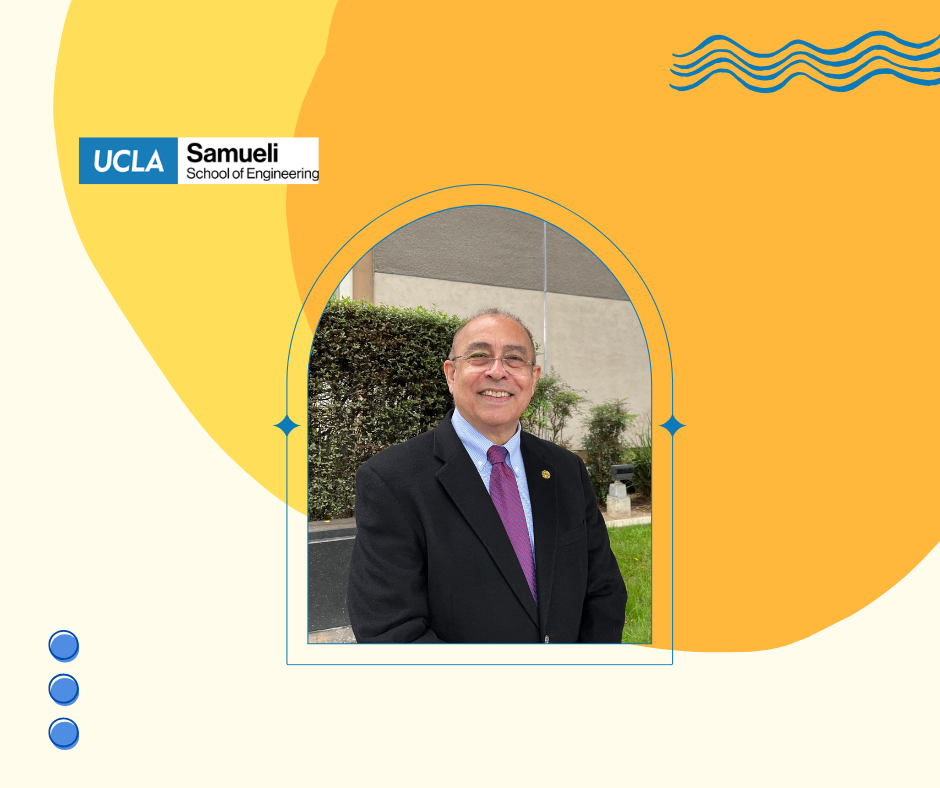
Photo Courtesy by Prof. Yousef Bozorgnia
The California Department of Transportation (Caltrans) has awarded a $1 million research contract to UCLA to lead a major new initiative focused on improving earthquake hazard characterization and seismic risk analysis of transportation structures, particularly bridges. This four-year project represents a significant step forward in the understanding and modeling of seismic hazards, with broad implications for infrastructure resilience and public safety.
“Caltrans has been a key supporter of earthquake engineering research for a long time, and we are very pleased they have selected UCLA to coordinate important earthquake engineering tasks,” said Yousef Bozorgnia, the project’s principal investigator and professor in the Civil and Environmental Engineering (CEE) Department at UCLA.
The research is being led through the Natural Hazards Risk and Resiliency Research Center (NHR3) — a multi-university initiative based at UCLA — and operates under the B. John Garrick Institute for the Risk Sciences (GIRS). In collaboration with the UCLA Civil and Environmental Engineering (CEE) Department, NHR3 manages a robust portfolio of projects focused on natural hazard mitigation, risk assessment, and infrastructure resilience.
In this new project, researchers will re-examine key uncertainties in earthquake ground motion models to enable more realistic and accurate computation of probabilistic seismic hazard, with a particular emphasis on the Western United States. The outcomes of this work will directly influence the seismic design of a wide spectrum of structures, including buildings, bridges, lifelines, and other critical infrastructure.
Additionally, the project will develop online tools to facilitate public access to the extensive earthquake databases compiled during earlier phases of Caltrans-funded UCLA research. These tools will support practitioners and researchers in applying the latest data and models to seismic hazard analysis and engineering design.
This effort builds upon the recently completed phase of research — a major community-based initiative known as NGA-West3, also coordinated by UCLA. As part of NGA-West3, a comprehensive and fully processed database of recorded earthquake ground motions was assembled. The database includes major earthquake data from the Western US as well as ground motions recorded in Greece, Iran, Italy, Japan, New Zealand, Taiwan, and Turkey.
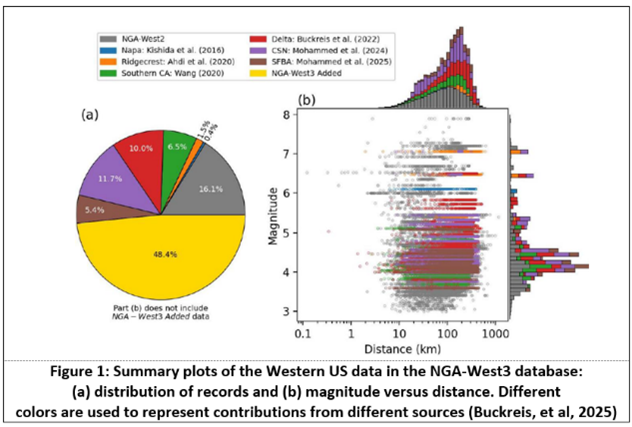
Image Courtesy by Tristan Buckreis/UCLA
Image of Western U.S. data in the NGA-West3 database: (a) distribution of earthquake records and (b) magnitude
versus distance
Figure 1 presents the key attributes of the recently developed database. This database has been instrumental in the development of multiple next-generation ground-motion predictive models, which are now being used by the U.S. Geological Survey (USGS) to develop national seismic hazard maps, which form the basis for seismic design codes.
In summary, the seismic design of nearly everything connected to the ground in the Western U.S. is being shaped by the research conducted through this initiative.
Learn more about NHR3 and its initiatives by visiting The B. John Garrick Institute for the Risk Sciences.
To stay informed about this project and its progress, please reach out to Prof. Yousef Bozorgnia at: yousef.bozorgnia@ucla.edu
This story is also featured on UCLA Samueli Newsroom: https://samueli.ucla.edu/ucla-garrick-risk-institute-awarded-1-million-caltrans-contract-for-earthquake-hazard-and-seismic-risk-analyses/